October 2026, Sami Lampinen
Your CRM Budget Is About to Get Rewired by Agents, Not Vendors
Gartner expects agentic AI to strip 116 billion dollars out of legacy application budgets by 2030, even as CRM spending keeps climbing toward 290 billion.
The paradox in the forecast
Gartner's newest enterprise application software forecast, as reported by Software Strategies Blog, tells two stories at once. Worldwide spending on enterprise applications is set to grow from roughly 496 billion dollars in 2026 to 813 billion by 2030, a healthy 12.8 percent annual clip. CRM is the single biggest beneficiary, growing from 170 billion to roughly 290 billion and capturing nearly 38 percent of all new spending in the category. Read quickly, this looks like a straightforward growth story for CRM vendors. Read closely, it is something else: Gartner expects cross-functional agentic AI to cannibalize 116 billion dollars of spending from traditional application software over the same period, with CRM, analytics and HR systems as the first places that value shows up. The money is flowing into CRM and out of "CRM as we have known it" at the same time.
Why more CRM spend does not mean more of the same CRM
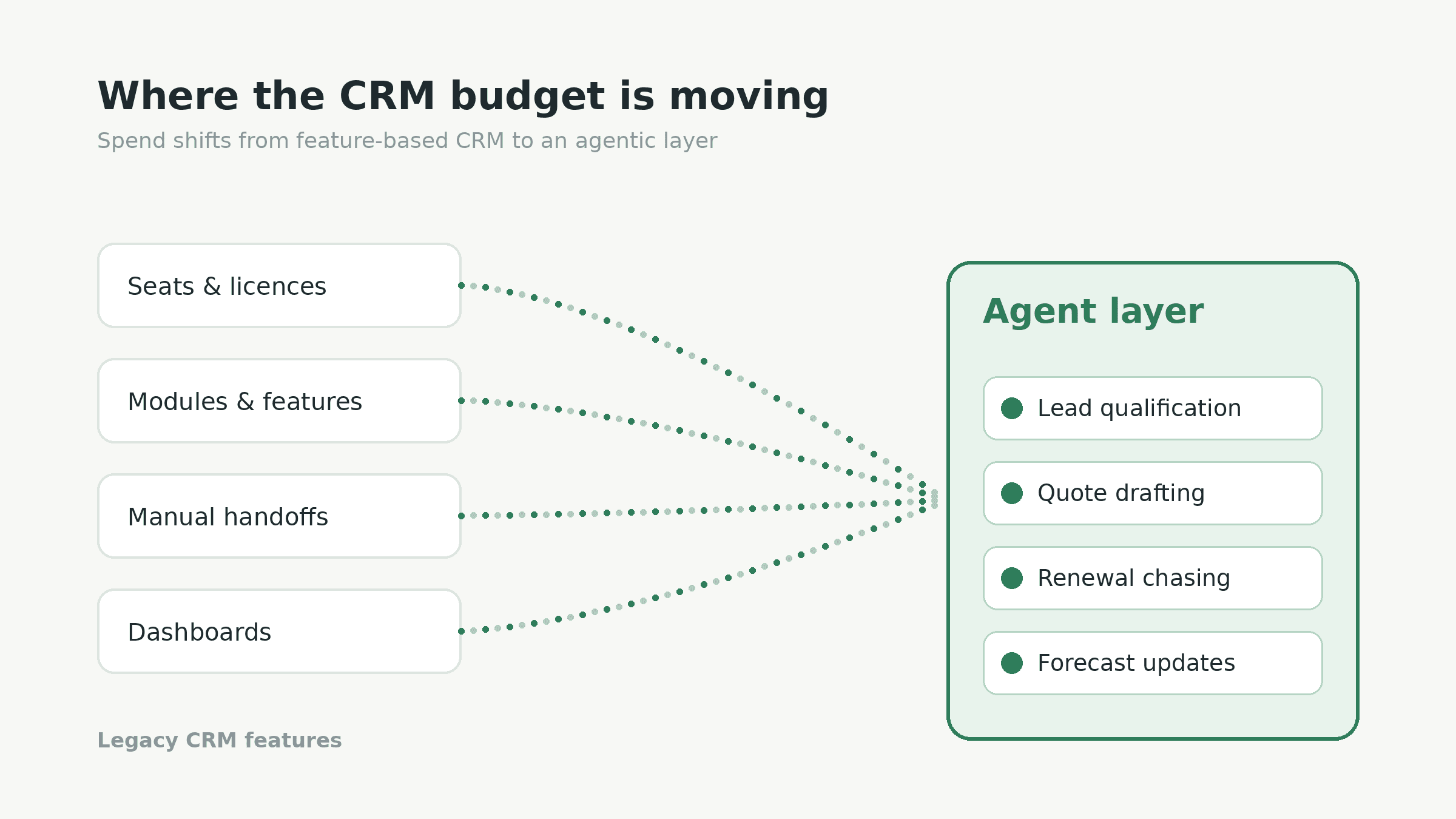
The growth is real, but it is not evenly spread across every CRM dollar in the budget. Gartner's own framing is blunt: legacy offerings that stay feature-based risk rapid obsolescence. The fastest-growing slice inside CRM is not new seats or new modules. It is agentic capability bolted onto, or replacing, the workflows a human used to run by hand: qualifying a lead, drafting a quote, chasing a renewal, updating a forecast. A platform that only stores and displays customer data is competing for a shrinking share of a growing budget, while the agentic layer above it is where the new dollars actually land.
What this means for your next CRM decision
Before renewing or expanding a CRM contract, ask the vendor a narrower question than "what features do you have": which of our manual handoffs (lead routing, quote assembly, pipeline hygiene) would an agent inside this platform actually take off someone's desk this year, rather than on next year's roadmap slide? Budget the agentic layer as its own line item rather than folding it into a generic CRM renewal, and revisit that line every two quarters rather than every contract cycle. The RevOps teams that treat this as a software upgrade will keep paying more for the same workflows. The ones that treat it as a labor reallocation question will be the ones this forecast is actually describing.
If a CRM renewal is coming up in the next few quarters, that is the natural moment to do this exercise. At Growberries we help teams run exactly that kind of review: mapping the manual handoffs in your revenue workflows, deciding which ones an agent should own, and redesigning the process and budget around it before the contract gets signed on autopilot.
Source: Gartner, "Forecast: Enterprise Application Software, Worldwide, 2024-2030, 3Q26" (G00862072), and the companion analysis "Spending on Cross-Functional Agentic AI Will Cannibalize $116 Billion of Spending From Application Software Markets by 2030", as reported by Software Strategies Blog, October 8, 2026 — softwarestrategiesblog.com